
Page Settings
Page Settings is the administrative panel for one page. It controls the layout of the page, the web address, the title, the organization picture, the permissions, the connected groups, and the published status.
Open Page Settings
- Go to a page where you have administrator access.
- Click the gear icon in the admin menu at the lower left of the page.
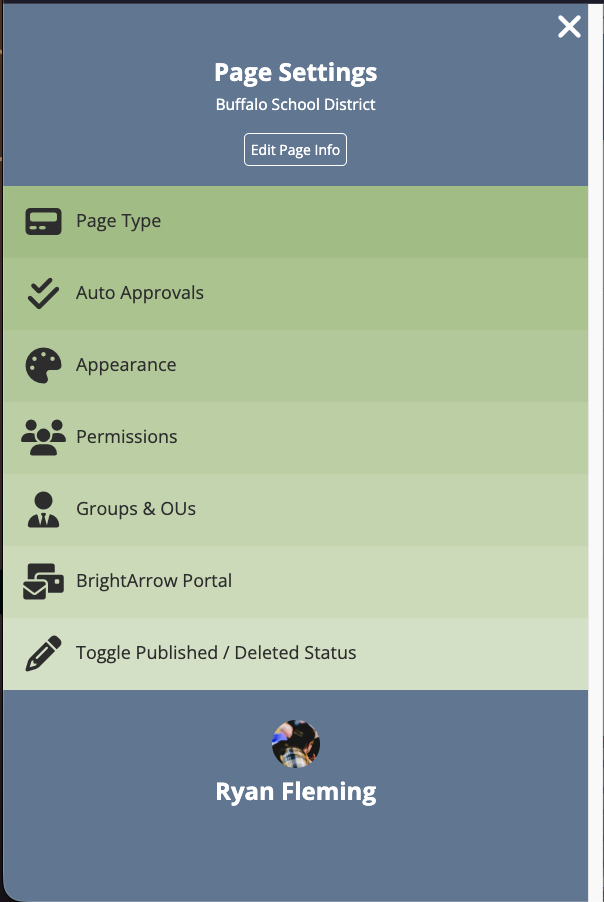
Page Settings requires administrator access. An editor can add and change content on a page, but an editor does not see the gear icon. For an explanation of each role, read User access and roles.
Which items appear
The items in the panel change with the page. A district home page shows fewer items than a section page.
| Item | Appears on |
|---|---|
| Edit Page Info | Any page that has a web address |
| Page Type | Every page |
| Pages Directory | The top-level page of your site only |
| Auto Approvals | Every page |
| Appearance | Every page except the top-level page of your site |
| Discussion Analytics | Every page, on sites that have CleverFeed configured |
| Permissions | Every page |
| Groups & OUs | Department, group, team, and section pages only |
| BrightArrow Portal | Every page |
| Toggle Published / Deleted Status | Page, classroom, department, group, team, and section pages only |
Three views have no Page Settings panel at all.
- A collection page such as
/schoolsor/pageshas a gear icon that opens Manage Members. - The calendar view has a gear icon that opens Manage Calendars.
- A shared files page has a gear icon that opens the delete control on its own, without the rest of the panel.
Edit Page Info
Edit Page Info is the button in the panel header. It opens two fields.
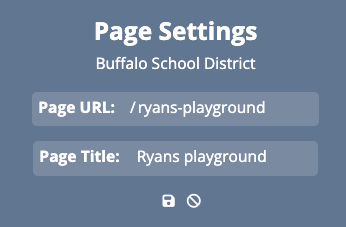
- Page URL: is the part of the web address after your domain name.
- Page Title: is the name that visitors read. It is also the label in your navigation menus.
Click the save icon to apply both fields.
Rules for the page URL
- The address cannot contain a slash, an underscore, a pipe character, a plus sign, or a space.
- Two pages under the same parent page cannot share an address. Capitalization does not make an address unique.
- Some addresses are reserved by the platform. Examples are
calendar,search,login,dashboard,content,gallery,directory,feed,notifications,sitemap.xml, androbots.txt. A reserved address returns a message such as The path 'calendar' is reserved and cannot be used.
Read this before you change a page URL
A changed address does not forward visitors from the old address. SchoolBlocks does not create a redirect. Every link to the old address stops working, including links in newsletters, in email to families, on printed flyers, and on other websites.
A changed title changes your navigation menus. The Page Title: field supplies the menu label, so a new title appears in every menu that links to the page.
If a page has no web address, Edit Page Info does not appear.
Page Type
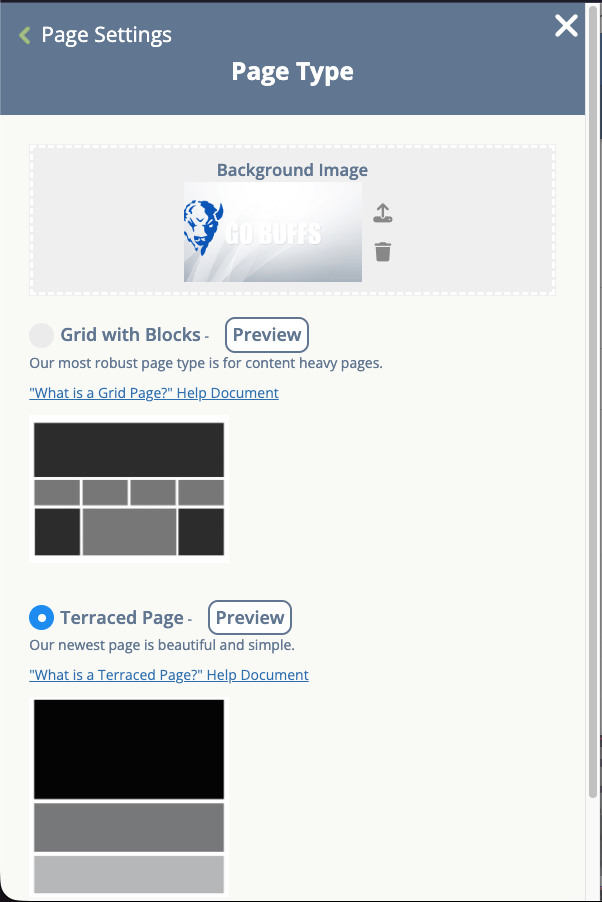
Page Type sets the layout of the page and holds the background image.
Layout
Two layouts are available.
- Grid with Blocks arranges content as blocks in a grid. Use it for pages that hold a large amount of content.
- Terraced Page arranges content as full-width sections stacked vertically. For more information, read Terraced pages.
Each layout has a Preview link. A preview opens the page in the selected layout without changing the page for visitors.
A change of layout does not delete content. The confirmation dialog states that the content you built in the other layout will not be lost, and you can switch back at any time. Check the page after the switch so that you know what visitors see.
Background image
The Background Image upload sits above the layout options.
- A file already under 1 MB is stored exactly as you uploaded it.
- A JPEG, PNG, WebP, or BMP file over 1 MB is shrunk automatically. The shrink reduces both the pixel dimensions and the quality, so start under 1 MB when detail matters.
- A GIF, SVG, or HEIC file over 1 MB is rejected with the message File is too large, please reduce to 1MB. The message names the size and not the file type, but the same file under 1 MB uploads without a problem.
- The server rejects any file over 2 MB.
- SchoolBlocks does not resize or crop the file on the server. The page displays the image cropped to fill the available width, so upload a wide landscape image and keep the important part of it near the center.
- The background image is inherited. A page with no background image of its own displays the background image of the nearest page above it. Use the trash icon to clear an inherited image from a single page.
Micro-Site
The Micro-Site toggle appears on the Grid with Blocks layout only. It is available on a classroom, section, group, department, team, or activity page that sits directly under your site's top-level organization.
Micro-Site adds a slide-out sub-navigation that lists the sections below the page. On that page, an editor also gets Create Section and Reorder Sections controls. Those two controls do not appear on the sections themselves.
If you never set the toggle, a page with three or more sections below it behaves as a micro-site automatically. Sections at any depth count, and draft sections count. Turning the toggle off keeps the sub-navigation off regardless of the number of sections.
Auto Approvals
Auto Approvals controls which pages may post content to this page without approval.
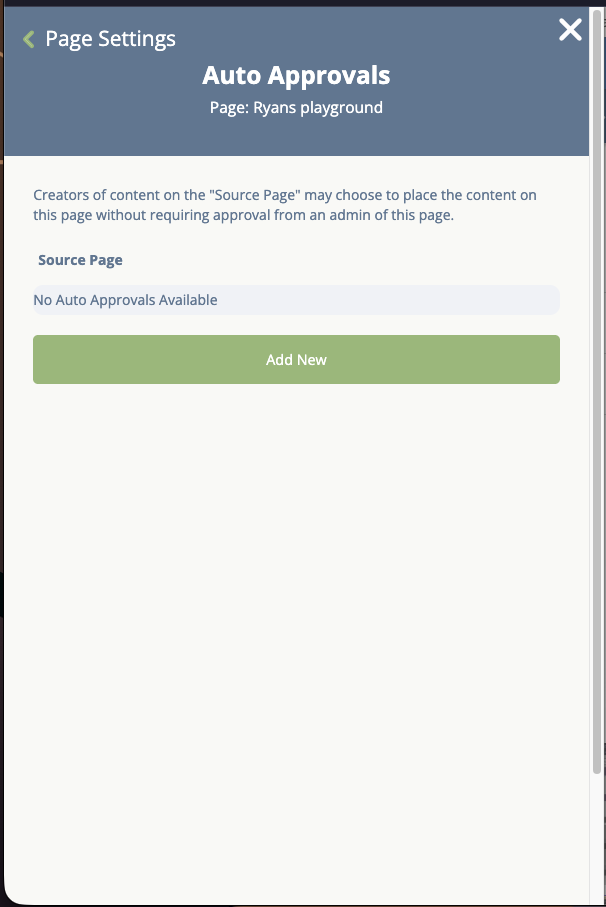
The page you are on is the destination. Each entry you add names a Source Page. Anyone who can create content on a source page may place that content on this page without a request to an administrator of this page.
Two points to know before you add a source page.
- An entry applies to content shared from that point on. Requests already waiting from that page stay in your approval queue. Approve them in My Dashboard.
- An entry cannot be edited. Remove the entry and add a new one instead.
For the rest of the sharing process, read Content sharing.
Appearance
Appearance holds the picture that represents the page.
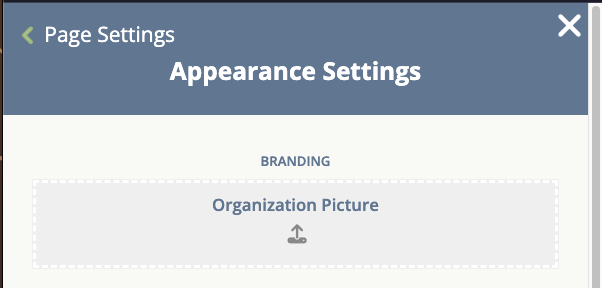
Organization Picture is the only field on a SchoolBlocks page. The picture appears where SchoolBlocks lists pages rather than displays them.
- In the Pages Directory, as the image beside each row. A page with no picture shows a generic file icon.
- In the school, district, and group blocks that build a collection page such as
/schools. A school or district with no picture falls back to a stock building photograph.
The file rules match the background image. Keep the file under 1 MB to avoid automatic shrinking, and note that the server rejects anything over 2 MB.
Neither of your logos is set here.
- The logo in the page hero is uploaded by clicking the logo area on the page itself.
- The logo in the top navigation bar applies to the whole site. Set it in Organization Settings, on the Appearance tab, under Branding.
Permissions
Permissions assigns roles to people and to groups. It also makes the page private.
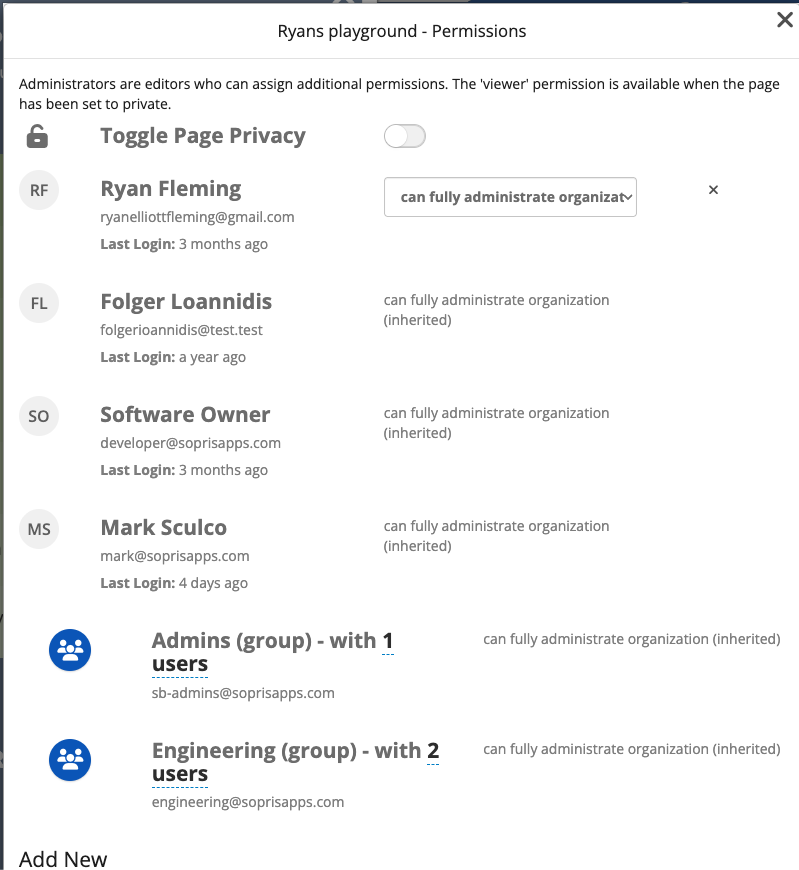
Roles
Three roles exist. The window does not print the role names on their own. It prints a description of each role instead, and the description is shorter in the Add New dropdowns than it is on a row that already exists.
| Role | In the Add New dropdown | On an existing row | What it grants |
|---|---|---|---|
| Administrator | can administrate | can fully administrate organization | Full administration of the page, including assigning permissions to other people |
| Editor | can edit | can edit content but cannot change permissions | Adding and changing content on the page, but no change to permissions |
| Viewer | can view | can view private content | Viewing a private page |
An administrator is an editor who can also assign permissions. An editor can also view.
Viewer is offered only when the page is private or unpublished. On a published public page the dropdown lists the administrator and editor descriptions only. Nobody needs a viewer role on a page that everyone can already read.
Assigning the editor role or the administrator role notifies the person by email, push notification, and in-app message, according to that person's notification preferences. A role that arrives through a group sync or a directory sync sends no notification.
Permissions are inherited downward
A role assigned on one page applies to every page below it. An administrator at the school level administers every section in that school. The window marks an inherited role as (inherited), and you remove an inherited role at the page where it was granted, not on the page below.
Page privacy
Toggle Page Privacy restricts the page to the people listed in this window.

- A private page is hidden from search results for signed-out visitors. A signed-in person sees the page in search results only if that person holds a viewer, editor, or administrator role on the page or on a page above it.
- A person without access who opens the address directly gets no content on the page.
- Privacy applies to every page below. Making a page private makes all of its descendant pages private. Making a page public makes all of its descendant pages public.
- A page cannot be public while a page above it is private. The attempt returns the message A page cannot be public if an ancestor page is private.
- A synced classroom cannot be made public.
- Toggle Page Privacy does not appear on the top-level page of your site.
Use page privacy to build a page before its audience sees it, or to keep a page for staff only.
Add a person or a group
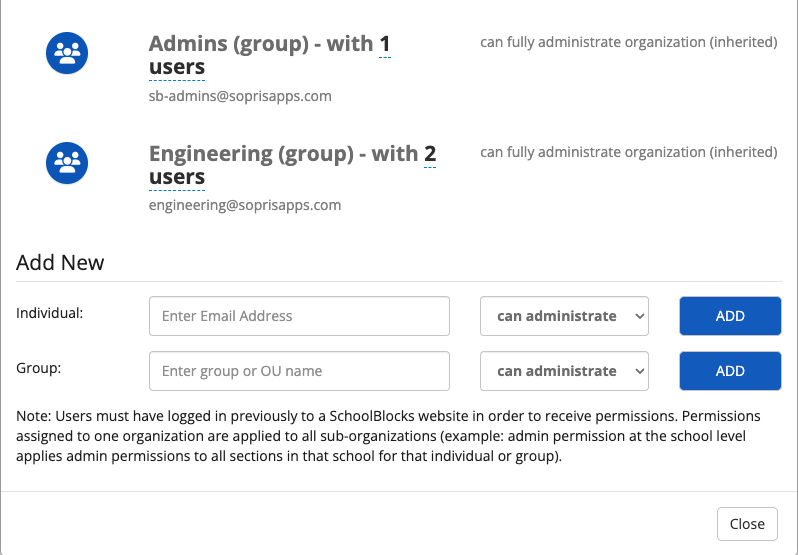
To add one person, enter the email address in the Individual: field, select a role, and click ADD.
To add a group, enter the group name or the organizational unit name in the Group: field, select a role, and click ADD. The Group: row appears only on a site connected to Google or Microsoft.
Adding a group assigns the role to every current member of that group, and it creates a SchoolBlocks account for any member who does not yet have one. Those members are not listed individually. The group appears as a single row that reads Engineering (group) - with 2 users. Hover the user count to see the names.
If the email address is not recognized, the window reports that the user does not exist. Two situations produce that message.
- The address is outside your connected Google or Microsoft directory and has never signed in to SchoolBlocks. Ask the person to sign in once, then add them again.
- The account is suspended in your directory.
An address that belongs to your directory works even if the person has never signed in. The note at the bottom of the window says that a person has to sign in first. That applies only to an address outside your directory.
Groups & OUs
Groups & OUs connects a group or an organizational unit from your identity provider to a user type on this page. It appears on department, group, team, and section pages. The window is titled Associated Groups & OUs after the page name.
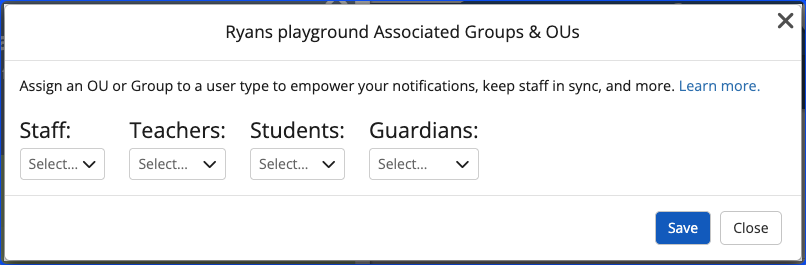
Assign one group or organizational unit per user type. The window keeps a single selection in each slot.
| Slot | What the assignment does |
|---|---|
| Staff: | Creates and maintains staff cards of type Staff for the members of that group |
| Teachers: | Creates and maintains staff cards of type Teacher for the members of that group |
| Students: | Creates and maintains student records for the members of that organizational unit |
Notes on the sync.
- Put each person in either the Staff group or the Teachers group, not both. Someone in both groups receives two staff cards on the page, one of each type.
- On Google, the Students: slot requires an organizational unit. If you select a Google group, the window reports success but the setting is not saved.
- A suspended account in your identity provider is skipped.
- A record that your identity provider stops returning is removed from the page on the next sync.
- If your site is not connected to an identity provider, the window says that group and OU syncing is not available and offers a link to the configuration page. There is no Save button in that state.
The Guardians: slot does not save. The dropdown appears in this window, but the setting is discarded. Contact support if you need guardians associated with a page.
This window and SIS roster sync are separate. Assignments here continue to apply on a site that also has a SIS connection. For background, read SIS roster sync and Staff directory sync.
BrightArrow Portal
BrightArrow Portal opens BrightArrow inside SchoolBlocks. Districts use BrightArrow for family communication and truancy calls.
The menu item appears for every administrator, whether or not the district has a BrightArrow account. Access depends on two things: a BrightArrow account on the district, and authorization of your SchoolBlocks sign-in username within that account.
If either is missing, the window reports You do not have an account for BrightArrow. The message is the same in both cases. Ask your BrightArrow administrator to confirm that the district has an account and that the username you sign in to SchoolBlocks with is authorized in it.
Toggle Published / Deleted Status
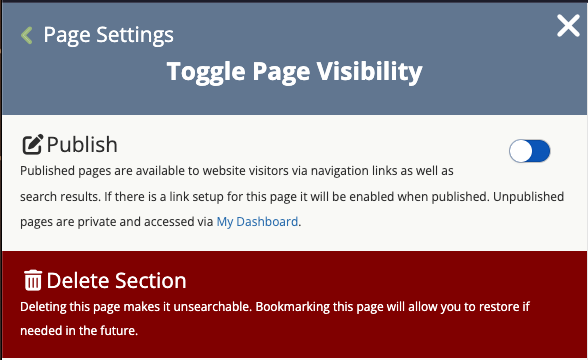
Toggle Published / Deleted Status opens a panel titled Toggle Page Visibility. It holds the publish control and the delete control.
This item does not appear on a district home page, a school home page, a top-level organization page, or an activity page. To take a whole site offline, contact support.
Publish and unpublish a page
Set the Publish toggle on to publish. Set it off to unpublish.
A published page is available to visitors through navigation links and through search results. A navigation link to the page is enabled at the same time.
An unpublished page is a draft. The draft keeps all of its content. It stays out of search results for signed-out visitors, navigation links to it are hidden, and a visitor without access gets no content on it.
Unpublishing is not a security control. A draft page can still respond at its own web address. Use Toggle Page Privacy for anything confidential.
The toggle applies to every page below. Unpublishing a page unpublishes all of its descendant pages and hides links to them. Publishing a page publishes all of its descendant pages, including any that you had deliberately left as drafts, so review them afterward.
A page cannot be published while a page above it is unpublished. The attempt fails with the message Could not change the status of the page. Publish the pages above it first, then try again.
The toggle takes effect immediately. Page Settings has no scheduled publishing.
Find a draft page
A draft is not in your navigation, so you cannot reach it the way you reach a published page. Your drafts are collected in one place.
- Go to My Dashboard.
- Open the Draft Pages tab.
- Click the page you want.
Look here first if a page disappears after you unpublish it.
Delete a page
- Open Page Settings and click Toggle Published / Deleted Status.
- Click the delete button. Its label names the page type, so a section reads Delete Section.
- Confirm in the dialog.
Deleting is reversible. SchoolBlocks keeps the page and its content. A deleted page is removed from search results for everyone, including administrators, and it is removed from your navigation.
Deleting a page also deletes every page below it, and it deletes blocks elsewhere on your site that display the deleted page.
Bookmark the page in your browser before you delete it. A deleted page is not in your navigation, so the bookmark is how you get back to it.
Restore a page
- Go to the deleted page, using your bookmark.
- Open Page Settings and click Toggle Published / Deleted Status.
- Click Restore Page. The button reads Restore Page on every page type, and the confirmation dialog names the type, for example Restore Section.
- Confirm in the dialog.
Two things to expect from a restore.
- A restore also restores content that you deleted earlier. The restore clears the deleted state from everything below the page, including blocks and sub-pages that you had deleted before you deleted the page. Review the page after a restore and delete anything you do not want back.
- A restore does not publish the page. Published status and deleted status are separate. A page that was a draft when you deleted it is still a draft after you restore it.
Unpublish or delete
Unpublish a page you intend to use again, such as an enrollment page you reopen each spring, or a page that is not finished. The page waits in Draft Pages, where it is easy to find.
Delete a page you no longer need. A restore is possible, but it takes more work and it can bring back content you had removed.
Find a page on your site
Pages Directory lists the department, section, and group pages on your site. It appears on the top-level page of your site, so start there when you do not know where a page lives.
Common questions
I unpublished a page and the menu link is still there. Refresh the page first. If the link remains, someone added it to the navigation by hand. Remove that link separately.
Does a private page show up in Google or in site search? A signed-out visitor gets no result for a private page and no result for a draft page. A signed-in person sees it only with a viewer, editor, or administrator role on the page or on a page above it. Someone who already has the address gets a page with no content on it.
I changed a page URL and now an old link is broken. SchoolBlocks does not forward the old address. Change the address back to restore the old link, or update the link at its source.
Why can I not select the Viewer role? The page is public and published. The viewer option becomes available once you turn on Toggle Page Privacy or unpublish the page.
Why does one person have two staff cards on the page? That person is in both the group assigned to Staff: and the group assigned to Teachers:. Remove them from one of the two groups in your identity provider.
Why is there no Groups & OUs item on my school home page? That item appears on department, group, team, and section pages only.
Why can I not unpublish my district home page? Toggle Published / Deleted Status does not appear there. Contact support to take a site offline.
Who can open Page Settings? An administrator of that page. An editor can change content but does not see the gear icon. For more information, read User access and roles.
Interactive walkthrough
Last updated: July 2026.